

Now Reading: Canada’s sentencing of Indigenous land defenders sparks outrage
-
01
Canada’s sentencing of Indigenous land defenders sparks outrage
Canada’s sentencing of Indigenous land defenders sparks outrage
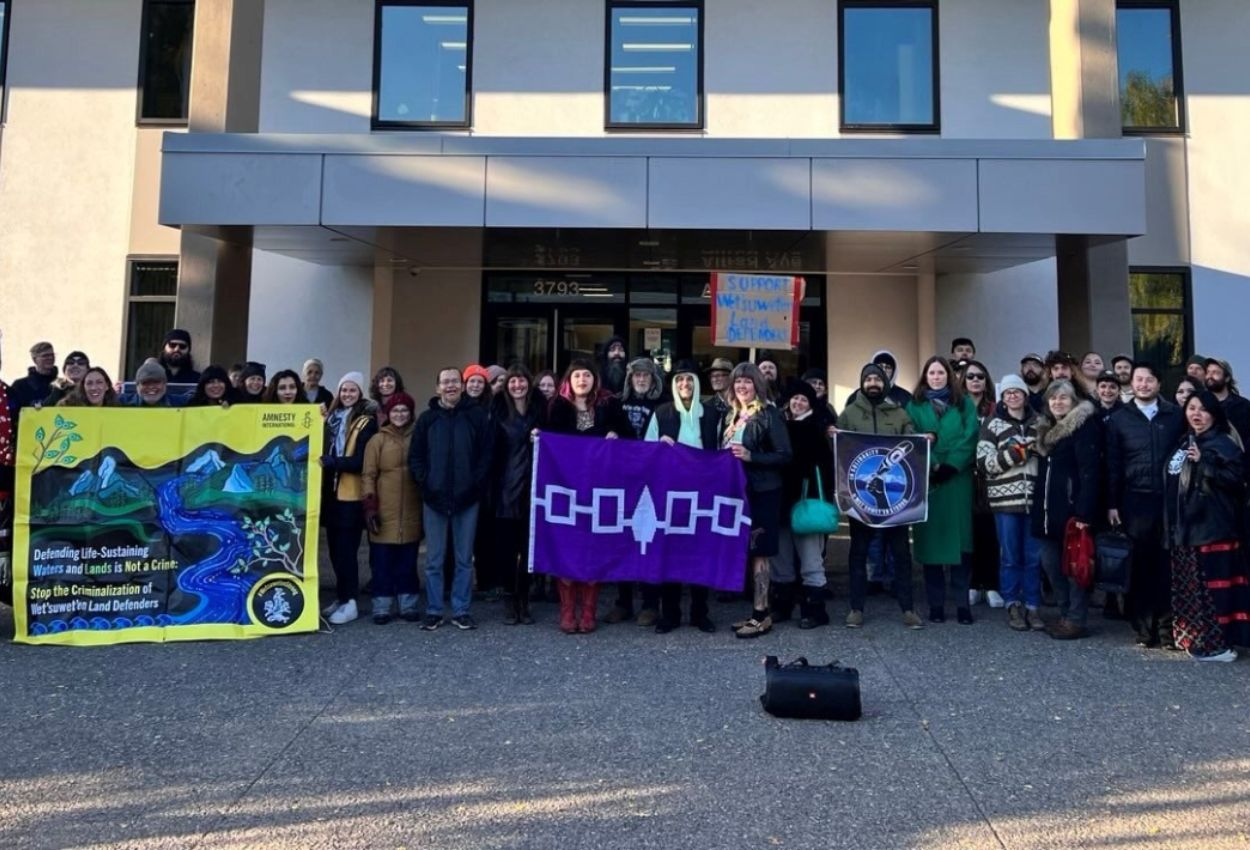
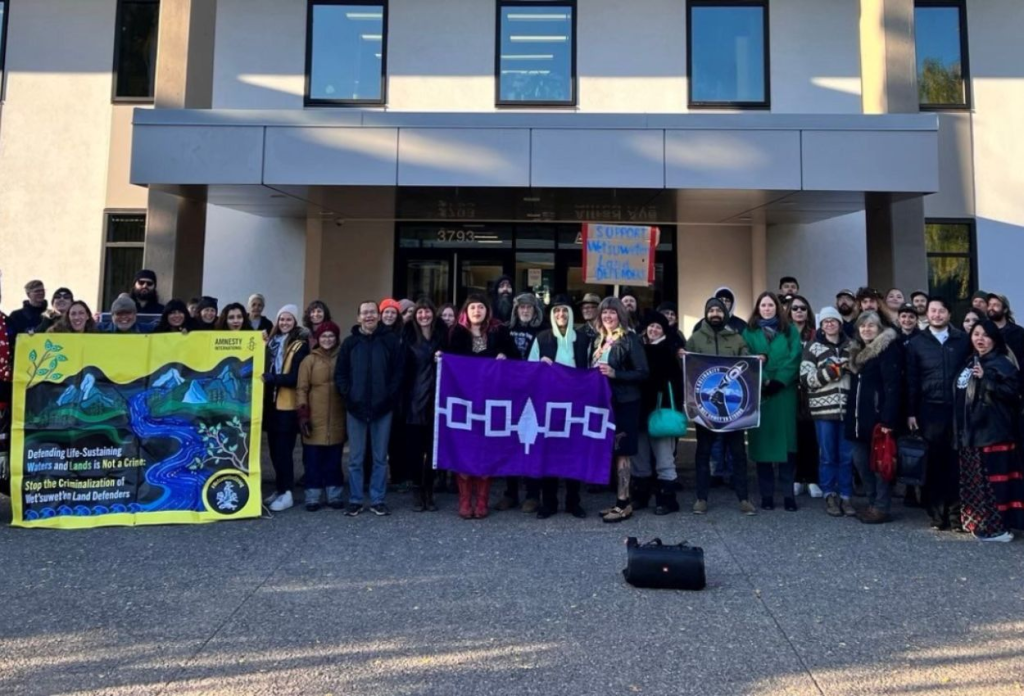
VANCOUVER — The sentencing of three Indigenous land defenders in British Columbia has drawn sharp condemnation from human rights advocates, who say the move sends a “chilling message” about the criminalization of Indigenous Peoples defending their lands and the environment.
On Friday, a B.C. judge sentenced Sleydo’ (Molly Wickham), a Wing Chief of the Gidimt’en Clan of the Wet’suwet’en Nation; Shaylynn Sampson, a Gitxsan woman with Wet’suwet’en family ties; and Corey “Jayohcee” Jocko, a Kanien’kehá:ka (Mohawk) from Akwesasne. The three were convicted of breaching a court injunction that prohibited land defense activities near the Coastal GasLink (CGL) liquefied natural gas pipeline project.
Each received jail sentences — 17 days for Sleydo’, 12 for Jocko, and nine for Sampson — though the judge suspended the jail terms and ordered 150 hours of community service instead. The decision to suspend the sentences, the court said, was influenced by the Canadian and British Columbian governments’ ongoing failure to respect the Wet’suwet’en Nation’s rights and governance.
“While we are relieved that Sleydo’, Shaylynn and Corey were allowed to walk free, the application of jail sentences — suspended or not — sends a chilling message to land defenders who act to protect Indigenous rights and territory in the face of destructive mega-projects,” said Ana Piquer, Americas Director at Amnesty International. “These courageous defenders should never have been arrested in the first place for exercising their rights and defending the natural environment we all depend on.”
The three were arrested during a heavily militarized Royal Canadian Mounted Police (RCMP) raid in November 2021 on unceded Wet’suwet’en territory. The police operation, carried out to enforce the injunction obtained by Coastal GasLink, led to widespread criticism from Indigenous leaders and international observers, who accused Canada of violating Indigenous sovereignty and international human rights law.
Legal and human rights implications
In February 2025, the B.C. Supreme Court acknowledged that the defenders’ rights were infringed during their arrests. In response to a claim of abuse of process, the court found that some RCMP officers had made anti-Indigenous racist remarks during the 2021 raid, breaching the Canadian Charter of Rights and Freedoms. However, despite recognizing the misconduct, the court declined to dismiss the charges.
Wet’suwet’en Hereditary Chief Na’Moks said the sentencing exposes the clash between Indigenous law and Canada’s colonial legal system. “In our law, the land defenders would have been rewarded for their actions, but under Canadian law, they face punishment,” he said. “They followed Wet’suwet’en law — ‘Anuk niwh’it’en’ — which stands for land, air, and water. Their law stands for punishment. We are slowly getting them to recognize our process.”
Amnesty International Canada called the convictions a stark reminder of systemic racism embedded in Canada’s justice system. “Even though the court recognized that they were subjected to racist and violent treatment during their arrests, the three defenders find themselves being punished,” said Ketty Nivyabandi, Secretary General of Amnesty International Canada’s English-speaking section. “The governments of B.C. and Canada have denied the Wet’suwet’en their right to free, prior, and informed consent and threatened their traditional way of life. These injustices are painful reminders of Canada’s colonial legacy.”
Amnesty said it would have designated the three as prisoners of conscience — a label it reserves for people imprisoned solely for peacefully exercising their rights — had the court imposed jail or house arrest. That designation has been used only once before in Canada, in 2024, when Wet’suwet’en Wing Chief Dsta’hyl of the Likhts’amisyu Clan was sentenced to 60 days of house arrest for similar charges.
Broader calls for accountability
France-Isabelle Langlois, Executive Director of Amnistie internationale Canada francophone, said the defenders’ treatment highlights the disproportionate risks Indigenous communities face amid the global climate crisis. “States must hold up, not lock up, Indigenous land defenders like Sleydo’, Shaylynn and Corey, and follow their lead toward a healthier, more sustainable future for all,” she said. “No one should be intimidated, harassed, or arrested for exercising constitutionally protected rights.”
Amnesty International’s 2023 report, Removed from our land for defending it: Criminalization, Intimidation and Harassment of Wet’suwet’en Land Defenders, documented a pattern of human rights violations against Wet’suwet’en members and their allies. It described at least four large-scale RCMP raids on Wet’suwet’en territory, resulting in more than 75 arrests since 2020.
The report also identified the Coastal GasLink project — led by TC Energy and backed by the federal and provincial governments — as a flashpoint for ongoing tensions. The 670-kilometer pipeline, which cuts across unceded Wet’suwet’en land, has been the focus of Indigenous resistance for nearly a decade.
Pipeline expansion continues
Despite widespread criticism, Canada, British Columbia and the project’s corporate partners are advancing Phase II of the Coastal GasLink pipeline, which aims to double the capacity of the LNG export terminal in Kitimat, B.C. The next phase includes seven new compressor stations — two of them on Wet’suwet’en territory — again without the free, prior and informed consent of the Wet’suwet’en Hereditary Chiefs.
Wet’suwet’en leaders argue that the project violates their traditional governance systems, recognized under both Canadian and international law. “These developments perpetuate colonial practices that undermine our sovereignty and destroy our land,” Chief Na’Moks said.
Amnesty International continues to call on the federal and provincial governments to end the criminalization of Indigenous land defenders and halt the expansion of fossil fuel infrastructure. “Indigenous Peoples are on the front lines of climate change and will face disproportionate harms if humanity fails to move on from burning fossil fuels,” Langlois said.
Broader implications
The sentencing, though relatively lenient in practice, underscores the broader legal and moral questions facing Canada as it reconciles its commitments to Indigenous rights with its economic and energy policies. While courts acknowledge violations against Indigenous defenders, punitive rulings continue to reinforce what advocates describe as a “two-tiered system of justice.”
“The land defenders stood to protect what international law already guarantees — the right to self-determination and to defend ancestral territory,” Piquer said. “Canada must stop criminalizing Indigenous people for protecting the planet we all share.”