


Now Reading: Two decades later, families of Pakistan’s disappeared still seek truth and justice
-
01
Two decades later, families of Pakistan’s disappeared still seek truth and justice
Two decades later, families of Pakistan’s disappeared still seek truth and justice
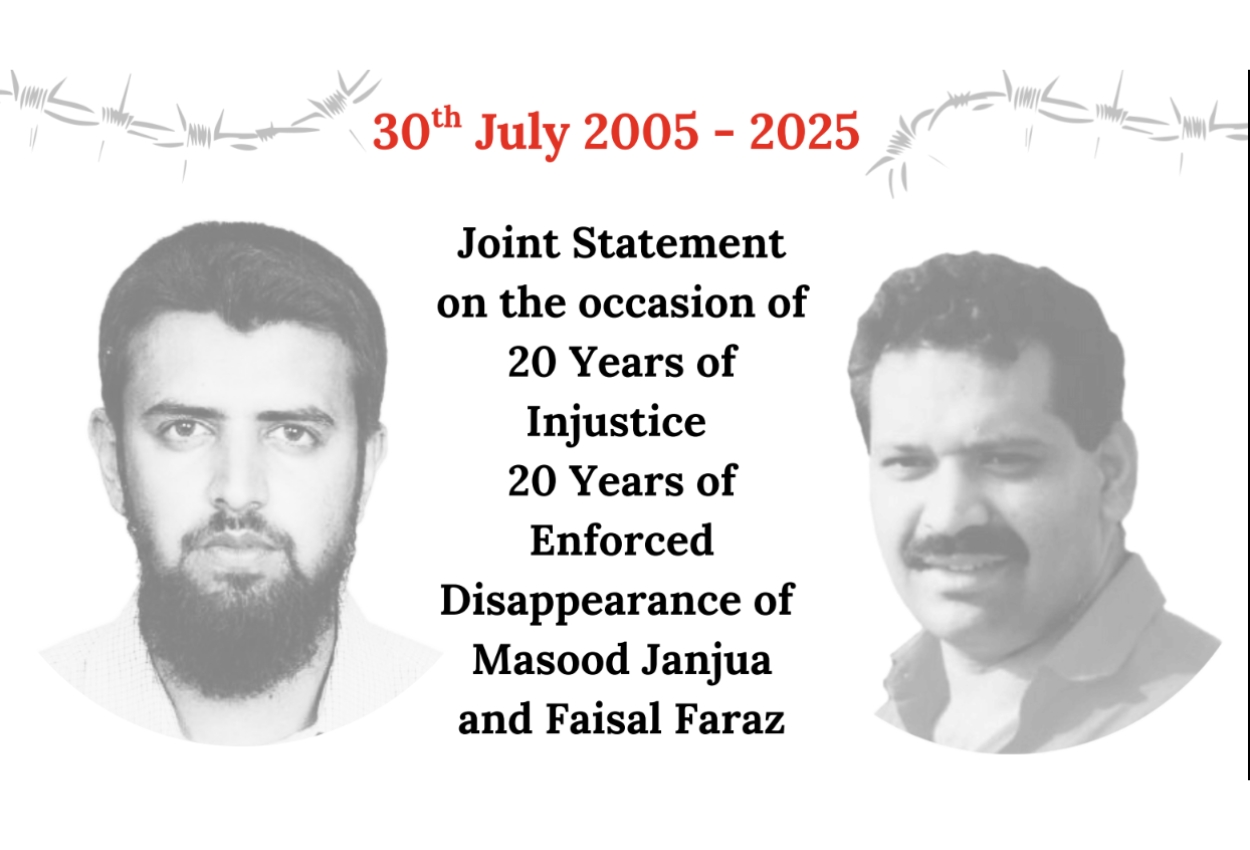
July 30, 2025, marked 20 years since the enforced disappearances of Masood Ahmed Janjua and Faisal Faraz—two Pakistani men whose unresolved cases have come to symbolize the country’s crisis of impunity and the global fight against enforced disappearances.
Janjua, an educator and entrepreneur from Rawalpindi, and Faraz, an engineer from Lahore, vanished on July 30, 2005, while traveling to Peshawar. Since that day, no official explanation has ever been given. Testimonies from former detainees like Dr. Imran Munir, along with public statements from lawmakers such as Member of National Assembly Abid Raza Kotla, confirmed that Masood was being held in a secret detention facility. Still, the Pakistani state has failed to acknowledge or investigate the case, leaving families with two decades of unanswered questions.
Their disappearance catalyzed a legal and human rights campaign led by Amina Masood Janjua, Masood’s wife, whose personal loss gave rise to the Defence of Human Rights (DHR). DHR has since documented over 3,500 enforced disappearance cases in Pakistan and filed more than 750 legal petitions. Despite this monumental effort, justice remains elusive.
In 2006, the Supreme Court took suo moto notice of the case, marking Pakistan’s first judicial recognition of enforced disappearances. But by 2018, the case was quietly transferred to the Commission of Inquiry on Enforced Disappearances (CoIoED)—a body widely criticized for its failure to hold perpetrators accountable. Although Constitution Petition No. 50 was revived in 2023 by the Supreme Court, it remains stuck in symbolic hearings. A request for video testimony from a key witness was met with chilling indifference. Then-Chief Justice Anwar Zaheer Jamali reportedly asked, “How far can we go for your case?”—underscoring the structural barriers to justice.
Janjua and Faraz’s disappearance marked the beginning of a broader pattern of state-sanctioned abductions. As of July 2025, CoIoED has registered 10,592 cases. Alarmingly, 125 new disappearances were reported in just the first half of this year, confirming that the practice continues unabated.
This joint statement, signed by 19 national and international human rights organizations, including FORUM-ASIA, AFAD, HRCP, Odhikar, and Mothers of Plaza de Mayo Founding Line, calls on Pakistan to take immediate and tangible action. These demands include:
-
Signing, ratifying, and implementing the International Convention for the Protection of All Persons from Enforced Disappearance (ICPPED).
-
Amending domestic laws to criminalize enforced disappearance under the Pakistan Penal Code.
-
Launching independent and impartial investigations into the disappearances of Masood Janjua and Faisal Faraz.
-
Prosecuting all those responsible, regardless of rank or position.
-
Providing reparations, rehabilitation, and comprehensive support to the families of the disappeared.
The human toll on the Janjua and Faraz families has been devastating. Their children, now adults, continue to carry forward the mantle of resistance, transforming private grief into a public movement for justice. What began as a struggle for two disappeared men has become emblematic of thousands of other families shattered by enforced disappearances.
As the world observes this 20-year milestone, the undersigned organizations reaffirm their commitment to truth, justice, and dignity for all victims. They remind the global community—and the state of Pakistan—that enforced disappearances are crimes that cannot be hidden behind bureaucratic silence or judicial inaction.
“We see you. We hear you. We stand with you,” the statement concludes, signaling a renewed vow by civil society to continue the fight until the disappeared are accounted for and justice is served.